TRACE: An Integrated Isotope-Tracing Framework for Metabolite Validation and Nutrient Fate Mapping
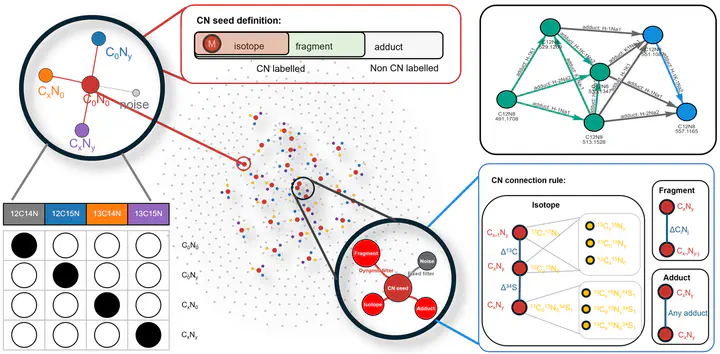 Graphical abstract of TRACE
Abstract
Untargeted LC-MS metabolomics offers a broad view of the microbial metabolism. However, its application is hindered by two intertwined challenges: distinguishing true biological signals from chemical artifacts and quantifying nutrient partitioning under nutrient-competitive conditions. Here, we present TRACE, an integrated experimental and computational framework that dynamically calibrates mass and retention time tolerances from the data itself to construct isotope-informed peak networks, enabling rigorous discrimination of biological metabolites from artifacts. Across four LC-MS platforms, TRACE reveals that the proportion of high-confidence annotations fell from 2.94 to 1.48%, while the total features increased by 331% from lower- to higher-sensitivity instruments. TRACE also maps nutrient fates into metabolic pathways by detecting isotopic dilution in Saccharomyces cerevisiae cultured with 13C-glucose, 15N-ammonium, and other unlabeled nutrients. Specifically, labeling of glutathione, a linear assembly of three amino acids, accurately reflect direct incorporation from its constituent amino acids; NAD+, whose biosynthesis proceeds through concurrent salvage and de novo pathways, revealed how adenine, tryptophan, and glutamine shaped its final isotopologue pattern. By converting untargeted LC-MS data into functional maps of nutrient flow, TRACE establishes a system-level approach to interrogate microbial metabolism under physiologically relevant competitive conditions.
TRACE is an integrated experimental and computational framework for untargeted LC–MS metabolomics. Fully labeled 13C-glucose / 15N-ammonium cultures supply high-confidence CN bundles that seed a peak–peak network; dynamic m/z and retention-time tolerances are learned from those seeds, then unlabeled nutrients are mapped by isotopic dilution.
The accompanying R package is TRACE (GitHub: DrRuiLi/TRACE). A project-level overview, including workflow figures, is on the TRACE project page.
Why a new framework
Untargeted LC–MS surveys microbial metabolism at scale, but two problems remain coupled: many detected peaks are adducts, fragments, or contaminants rather than cell-made metabolites, and classical tracing follows one labeled substrate at a time. TRACE treats isotope-confirmed peaks as network seeds, calibrates error tolerances from those seeds, and asks how cells partition competing carbon and nitrogen sources.
Main results
- Calibrated networks. Complete unlabeled / 15N / 13C / dual-label CN bundles (Pearson ρ > 0.75) collapsed ~25,000 features to 1,098 high-confidence seeds in a representative positive-mode data set, from which data-driven m/z and RT tolerances are learned.
- Better assignment than pairwise methods. Global network assignment grouped adducts, fragments, and isotopologues of one metabolite, removed large m/z/RT errors seen in PAVE, and recovered missed features. About 70% of TRACE-annotated peaks matched HMDB, YMDB, KEGG, or an in-house database.
- Sensitivity is not biology. From Q Exactive Plus to Excedion Pro, total features rose 331% while TRACE-validated metabolites rose 117%, and the share of high-confidence annotations fell from 2.94% to 1.48%.
- Nutrient fate under competition. Unlabeled leucine, threonine, tryptophan, adenine, uracil, acetate, or a 14-compound mixture diluted the labeled background in a pathway-selective way. Glutathione tracked linear amino-acid assembly; NAD+ revealed concurrent salvage, de novo, and independent nitrogen entry.
Software versions
| Version | Role |
|---|---|
v1.0.0 | Code used for this article |
main (1.1.0+) | Ongoing development |
devtools::install_github("DrRuiLi/TRACE", ref = "v1.0.0")